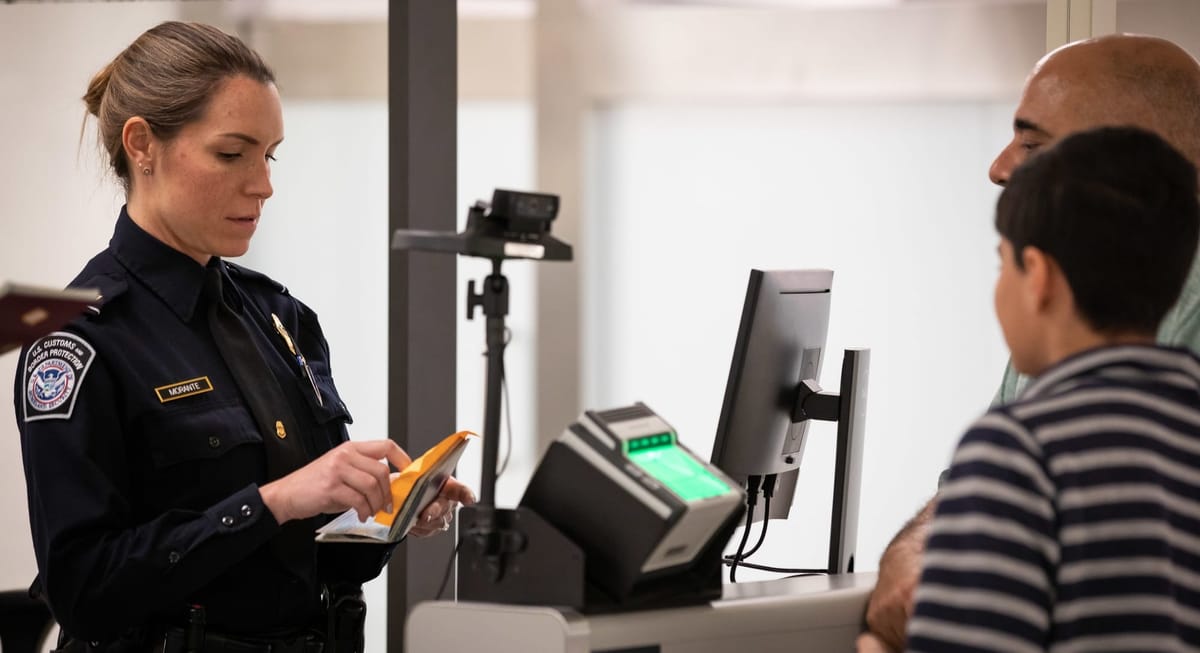
The United States requires most travelers to provide all 10 fingerprints and a digital photograph at the border. This applies to travelers who need a visa, as well as those from Visa Waiver (ESTA) countries.
Data collected during the visa process (if required) or on your initial visit to the country will be used at subsequent visits to verify your identity, and will be used by Immigration & Customs Enforcement (ICE) to identify you during an encounter.
As with many countries, the US also retains all accessible biometric data on your passport. This data will vary depending on your nationality.
Exemptions
Those under the age of 14 or over the age of 79 are exempt from fingerprinting, but a digital photograph will still be required.
Diplomats, Canadians (on B1/B2 visas) and other special categories used to be exempt from digital photographs, however this exemption has been removed by the Trump administration since December 26th 2025. These special travelers remain exempt from fingerprint collection.
How long will my data be stored?
Fingerprints taken from travelers will be stored in IDENT for 75 years from the last encounter. Photographs will also be stored for 75 years in the Traveler Verification System (TVS). Photographs taken of US citizens will be retained for a maximum of 12 hours.
The US has a long history of not following their own laws regarding data collection and storage. It can reasonably be assumed they are also unlikely to abide by the regulations on data retention regarding border clearance too.
Are biometrics optional?
Biometrics are not optional for any non-US citizens. Refusal to provide biometrics will lead to detention and likely deportation.
Who is my information shared with?
The US has strong partnerships with other countries and openly share immigration biometric data with: UK, Canada, Australia, New Zealand.
Additionally, consecutive administrations have pushed for bilateral biometric database access as a condition of Visa Waiver status - essentially any country that wishes to qualify for Visa Waiver status must share their biometric databases with DHS in order to retain their status past 2027. The Visa Waiver country in return would be able to query the US's biometric databases.
Read more about the EU's negotiations with the US at Statewatch: https://www.statewatch.org/news/2025/december/us-access-to-eu-citizens-biometric-data-ministers-approve-eu-negotiating-mandate/
Biometric exit mandate
The US has been seeking to expand biometric collection to exit procedures. This is complicated as typically one does not need to pass through border clearance to leave the US. The solution proposed by DHS is biometric terminals located at the bordering gate for flights.
If this system is in place at your departure airport, you must undergo biometric screening to leave the country. The only exemption is for US citizens. Refusal to undergo biometric screening when leaving the country can violate your immigration status and could potentially lead to detention and deportation.
If you attempt to leave the country without a valid entry record (No Match), a CBP officer will be called to verify you status. If you have not previously provided fingerprints, CBP will take these prior to allowing your boarding.
Read more in the Federal Register: https://www.federalregister.gov/documents/2025/10/27/2025-19655/collection-of-biometric-data-from-aliens-upon-entry-to-and-departure-from-the-united-states
Deportation & ICE
It is worth noting that the US is seeking to expand their biometric data collection for anyone detained by DHS. if you are detained by DHS (including ICE), it is likely your iris prints will also be stored in IDENT along with your fingerprints. DHS has been unclear on if this applies to US citizens.
Source: https://fedscoop.com/customs-and-border-protection-biometric-iris-recognition/
Returning Travelers
If you are a returning traveler to the US, the process may not include fingerprint verification if your identity can be verified via a digital photograph. This is a new system CBP has rolled out called Simplified Arrival. More details can be found here: https://www.cbp.gov/sites/default/files/2025-03/biometrics_tear-sheets_cbp-simplified-travel_air-entry-exit-tear-sheet_english.pdf
If a facial recognition image is enough to verify my identity, why collect fingerprints?
DHS has been clear in published documents around Simplified Arrival, they believe facial images are enough to meet the biometric entry requirement as set out by Congress. Fingerprints continue to be collected on the first encounter as it serves a dual purpose of immigration and traditional law enforcement. Fingerprints collected can be use by many US government departments for criminal investigations.